SESSION I: WHAT IS A UNIVERSITY?
Discussion leaders: Jennifer Frey and Kavin Rowe
Alasdair MacIntyre, Three Rival Versions of Moral Enquiry (Chapter 10)
John Courtney Murray, We Hold These Truths (Chapter 5)
Report of the Harvard Committee, General Education in a Free Society (Chapter 2)


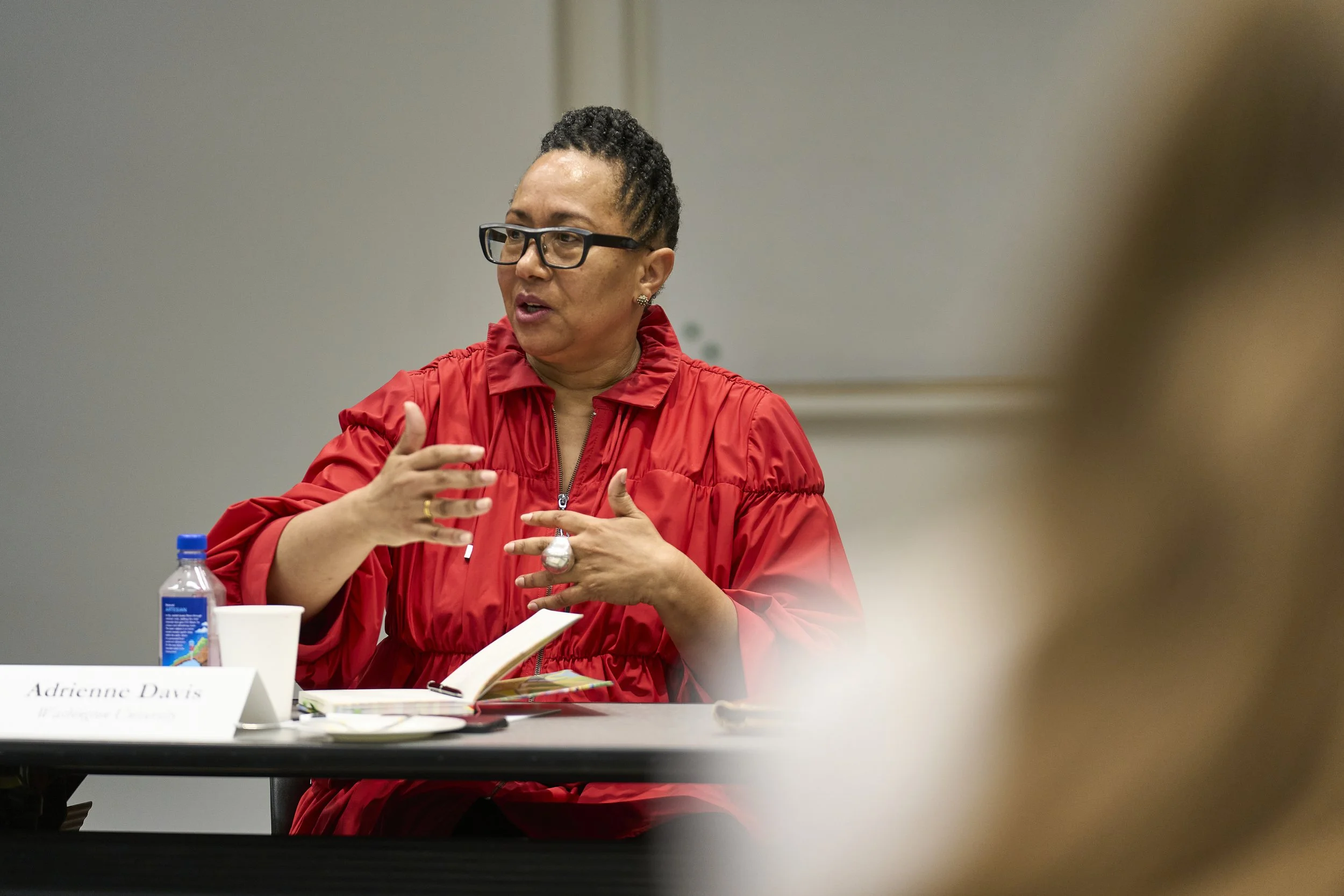
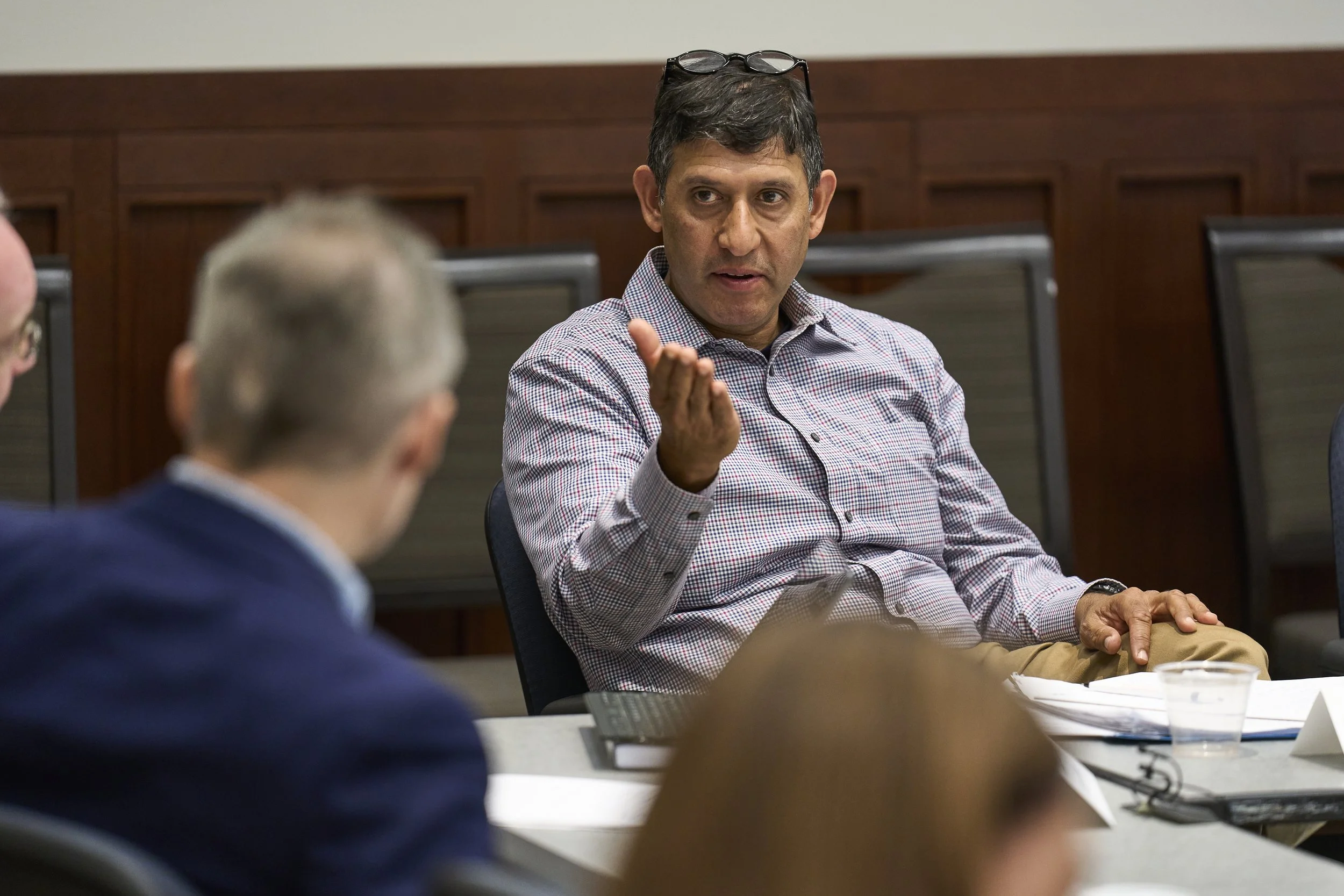
Kavin Rowe: The title of this first session is What is a University? My ambitions here are modest. I want us to think about how we think about that question—what a university is, or might be, when we’re already thinking about it. Too often, conversations about universities start in medias res: in the middle, with assumptions already in place.
So let me begin by sketching five ways that people often think about universities:
Platonic: The university is an ideal form. Every university participates in this form to greater or lesser degrees, and all are judged in its light.
Aristotelian: We look at actual universities—there are over 4,000 in the U.S.—and, from them, we create a picture of what the university should be at its best, in light of its purpose.
Pragmatist: The university is simply what works best for now. Forget what it “really” is supposed to be; it emerges from ongoing conversations and judgments.
Political: Universities exist for a certain sociopolitical life. To the extent they uphold that life, they are good; to the extent they undermine it, they are not fulfilling their purpose.
Religious: Because universities pursue truth, they are inescapably oriented toward God, the ground of all truth. When they exclude God, they lack an objective sense of knowledge as it has been understood throughout history, and they fall short of being true universities.
There are more categories we could name, but these five help reveal the frameworks we already bring to the question.
Second, let me offer a definition: the university is a contingent institutional arrangement—contingent, not necessary in the grand scheme of human life—that allows us to deal nonviolently with irreconcilable differences while still pursuing truths that can be known by human beings before we die.
Think about it: most of human history has been violent. That universities provide a space where permanent and irresolvable disagreements can stand without violence—that is a remarkable achievement in the history of the world.
“Think about it: most of human history has been violent. That universities provide a space where permanent and irresolvable disagreements can stand without violence—that is a remarkable achievement in the history of the world.”
— Kavin Rowe
Finally, two questions:
Democracy: Is the main job of the university to support modern Western-style democracy? Or does the university require democracy in order to flourish? If yes, then the university becomes a tool of a wider political program—incapable of genuinely questioning whether democracy is the best way to order society. That might be fine, but it would also reduce the university to one expression of democratic life.
Theology: What role do religious commitments have in a university that isn’t explicitly religious? McIntyre has argued that contemporary universities offer no place for morally committed modes of inquiry. But in my experience at Duke Divinity, that’s not entirely true. I’ve seen reactions ranging from rejection (“that doesn’t belong here”) to curiosity (“what do you do over there anyway?”) to genuine interest. Some of my most stimulating conversations have been with scientists—atheists, astrophysicists—precisely because we disagreed about the deepest questions.
The university, I think, must remain committed to truth claims—even those rooted in religious traditions. To screen them out is to lose sight of something essential to the university’s identity and flourishing.
Jennifer Frey: Thank you, Kavin. So, what is a university? That question can be heard in two registers.
First, the sociological: here, there is no single “university.” There is a multiversity. No unity. Nothing that ties all the activities of contemporary universities together toward a single end.
Second, the philosophical: what should the university’s single organizing telos be? That’s the question I want us to press.
Universities call themselves “higher education.” But what makes it higher? Costs are higher, years of study are higher—but those aren’t good answers. Historically, it was obvious: not all knowledge is equal. Some knowledge is genuinely higher, more worth seeking. That was common sense. But today, very few people can answer that question. That, in itself, shows how dire things have become.
Cardinal Newman defined the university as an institution dedicated to seeking and teaching universal—or philosophical—knowledge. He meant the habit of integrating each discipline into a synoptic vision of truth, consistent within itself, making sense of the whole. The goal was wisdom—not just truth. Memorizing dorm phone numbers gives me “truth,” but not wisdom.
If wisdom is the goal, then: why do we need to be wise? What is it to be wise? And how do we structure the university so that all are pursuing this goal? That leads us directly to general education.
I am convinced the crisis of the humanities is tied to the broken state of general education. Until we fix gen ed, liberal learning will remain marginalized. The 1945 Harvard Report on general education was extraordinary—visionary. But it went nowhere. Why? Reports often go nowhere.
So, what ought every student to know? Not just in terms of content, but in terms of the kind of knowledge pursued. And then, who gets to decide? Presidents? Provosts? Trustees? Faculty? Committees? In practice, revising gen ed is a nightmare.
This ties into other challenges:
Hyper-specialization: How can universities credibly claim to educate free human beings and citizens, not just narrow technicians?
The multiverse problem: Universities today contain radically disconnected spheres—athletics, student affairs, research—all pulling in different directions. Worse, many scholars deny that “truth” is their goal at all, either rejecting truth entirely or limiting it to their own discipline. I once sat on a panel where an evolutionary biologist insisted nothing I said could be true or false—only what he did counted as knowledge. This is common, and it makes coherent gen ed almost impossible.
So, for me, the urgent questions are:
How do we recover an idea of higher education as the pursuit of wisdom?
How do we reform general education to reflect that?
Who gets to decide what counts as “higher” knowledge in institutions that have become fragmented multiversities?
Frank Lovett: Listening to both of you, I kept thinking about democracy and the university. For most of history, universities did not exist in democracies, so democracy cannot be essential. We would still want universities even in non-democratic regimes. But two thoughts follow. First, if the university is a place where people talk without violence, then it already contains a kernel of democracy. That kernel could persist even outside a democratic society. Second, even if democracy isn’t essential to the university’s essence, universities inevitably take on responsibilities in their particular contexts. In our society, that may include supporting democracy, not because it is their essence, but because circumstances impose those obligations. So universities may always carry a democratic kernel, and they may also acquire contingent democratic responsibilities.
Jennifer Frey: That’s interesting, Frank. But here’s a hard question: do deeply illiberal or anti-democratic thinkers belong in the university? Many current theorists question core commitments of our liberal democratic order. Should they be here?
Frank Lovett: Yes, I think so. Mill said that “he who knows only his own side knows little of that.” To have real debates about democracy, we need participants who genuinely doubt it. That’s part of how the university contributes to democracy: by re-litigating the case for it, again and again, against those who challenge it.
To have real debates about democracy, we need participants who genuinely doubt it.
— Frank Lovett
Chad Wellmon: I’m skeptical even of the “kernel of democracy” idea. Historically and institutionally, universities’ democratic character often manifests through federal funding. At UVA, for example, federal dollars keep the health system running—that’s two-thirds of our budget. That’s a very narrow, financial version of “democratic obligation.”
But historically, especially in the late 19th century, American universities made radical claims about their role in a democratic polity. That was new. So maybe the question is: can universities truly be the kernel of democracy, or are they simply entangled in state structures like funding?
Elisabeth Kincaid: That raises another issue: who in the university is supposed to be doing the work of formation? Newman assumed it was the faculty. But in practice, student-affairs professionals often assume it’s their job. They see themselves as forming students—ethically, civically—while faculty focus only on teaching or research. That creates a parallel “other university” with very different assumptions about its mission.
Johann Neem: Historically, after the American Revolution, the question was: what kind of knowledge does a leader of a republic need? That shaped the early colleges. Today, the challenge is different. In a democracy, people are free to learn outside institutions. You can read critical race theory in your basement with friends. No one forbids it. What’s at issue is whether taxpayers should fund it. That means universities must justify themselves to the public. They have to show that their knowledge serves the common good—defense, civic leadership, science. That’s why the university’s loss of public trust is so dangerous. Democracies don’t owe universities support; universities must persuade democratic publics they are worth funding.
Suzanne Shanahan: I’ve seen this contrast firsthand. When I moved from Duke to Notre Dame, I immediately noticed the difference between a secular and a Catholic university. At Notre Dame, there’s an assumption of shared purpose and common good. Faculty contributions to that shared good are explicitly part of tenure reviews. Every first-year student takes a seminar that begins with Notre Dame’s mission statement and the Congregation of Holy Cross’s mission. The themes—solidarity, truth, justice—form a foundation. And remarkably, 140 faculty volunteered to teach those seminars as overloads. That sense of shared mission is powerful. At secular institutions, by contrast, you often see faculty saying, “I just want to be left alone to do my own thing,” while the university grows its endowment and real estate without any clear sense of purpose.
“Universities must persuade democratic publics they are worth funding.”
— Johann Neem
Abram Van Engen: I teach a freshman course where students articulate their “purpose” for being in college. The answers range from “do as little work as possible to get a degree and make money” to “learn as much as I can about the world.” Universities try to accommodate all of that. The problem isn’t no purpose—it’s too many purposes. They accumulate over time until the university is trying to do everything. Still, universities do provide rare spaces for serious conversation. Our public lectures attract community members who are thrilled just to hear ideas debated. That’s something worth defending.
Roosevelt Montás: We’ve slipped into assuming that “education” is the core of the university. For many research universities, it isn’t. When Trump attacked higher ed, universities defended themselves by emphasizing research—cancer cures, scientific preeminence—not by saying “we educate citizens.” The modern research university is fundamentally a financial enterprise, with trustees prioritizing fiduciary interests. Education, citizenship, democracy—those are secondary functions at best. Still, the project of knowledge-seeking requires democratic norms: equality among peers, openness, free discourse. Yet higher education also entails hierarchy—it is higher learning. That’s always been in tension with democracy. Socrates’ execution reminds us how uneasy that relationship can be. If we want to recover the educational function, we have to focus on general education. That’s where universities could reclaim a unifying vision.
“The modern research university is fundamentally a financial enterprise, with trustees prioritizing fiduciary interests. Education, citizenship, democracy—those are secondary functions at best.”
— Roosevelt Montás
“The problem isn’t no purpose—it’s too many purposes. They accumulate over time until the university is trying to do everything.”
— Abram Van Engen
Chad Wellmon: When university presidents responded to federal pressure, education was barely mentioned. Outputs—jobs, health care, research dollars—dominated. Education is tertiary at best.
Historically, though, figures like William Rainey Harper at Chicago cast the university as the “priest” or “prophet” of democracy. That vision was radical: the university as partly independent of the state, but also serving the democratic public. Postwar universities took up similar ideas, even if in different language.
Frank Lovett: Let me push back. I don’t think universities are inherently elitist or undemocratic. If their essence is the production, preservation, and transmission of knowledge, that’s not elitist in itself. It’s like farming or trade—just another necessary social function. Pursuit of knowledge can be democratic to the extent it follows the force of the better argument. The elitism comes from extra roles universities have taken on—credentialing, reproducing privilege, exclusivity. Those are contingent. Given those roles, universities do acquire democratic obligations. But that’s not built into their essence.
Kavin Rowe: Two quick observations as we wrap up. First, Jen’s question is right: what makes universities higher education? Without that, why call them universities at all? Second, nearly every comment assumed that to ask what a university is requires asking what it’s for. We kept rejecting the fact/value distinction. That tells us something: when we ask about the university’s essence, we can’t separate it from its purpose.