SESSION III: CHALLENGES
Discussion leaders: Johann Neem and Elisabeth Rain Kincaid
Evan Mandery, Poison Ivy (Introduction & Chapters 1-2)
Chad Wellmon, After the University (forthcoming) (selections)


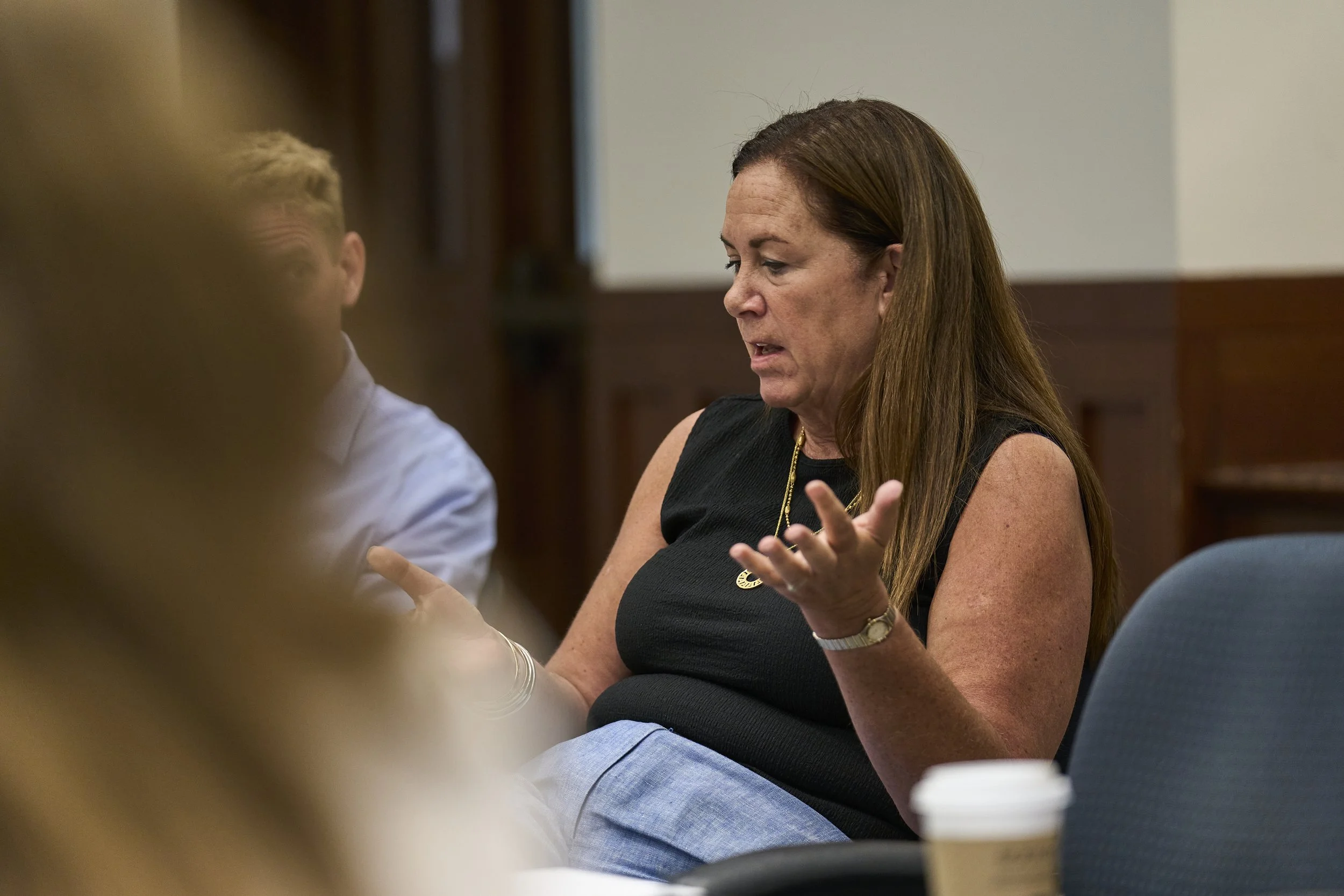

Johann Neem: If some of the prior panels we focused on what the university should be, these two readings force us to confront, as Chad puts it, the university as it actually exists. And neither Chad nor Evan give us the best, most pleasant portrait of the university as it actually exists. Evan makes clear the primary function he sees is class reproduction. The university also encourages downstream residential segregation. And it creates a race to the top that is so intense that it has downstream effects on our democracy.
Chad offers a different window. He suggests that universities are complex bureaucracies beholden to multiple stakeholders and delivering various services, all of which mean something to their various clients. Chad asked us to consider the ways in which the internal goods of higher education are always at risk or in his assessment may already have been overwhelmed by the external goods.
First, I want to suggest there might be a tension that we can work with between Chad’s and Evan’s understanding of the university. Evan implicitly says the goal of university is to offer social mobility. Is this an internal good? In Chad’s framing, I think it would be an external good.
I want to flip that around in the spirit of Evan’s piece and also ask what are the moral costs of elite higher education on the moral formation of the children trying to get into those schools. Those of us who have all been through this recently know that the game of getting kids into school makes us all at times instrumental. I wrote a book about the virtue ethical purposes of college, and at the same time I told my son he should diversify his activities for his college applications. He said, “Didn’t you tell me I’m supposed to love education for its own sake?” And I said, “Yes and live in the world.” If these schools are producing our leaders, what kind of moral formation are we doing to get them into these schools that they’re going to bring with them and think about in college and eventually when they become our society’s leaders? What are the long-term costs?
“If these schools are producing our leaders, what kind of moral formation are we doing to get them into these schools—and what kind will they carry into the world?”
— Johann Neem
I want to turn also to Chad’s argument. Chad echoes prior scholars when he points out that elite colleges seek excellence without a soul. George Marsden makes a similar point, but what I think is really important here is that Chad thinks there should be a soul and that soul is disciplined study. And I think this is really important for the set of readings we have because, on the one hand, he is challenging MacIntyre's reading by claiming that the formation of intellectuals is an ethical and teleological undertaking. I would say Chad sees the encyclopedic project as in itself Aristotelian. But in doing so, Chad is also challenging Fish’s minimalist and pragmatic framing. To Fish, there is nothing ethical about forming intellectuals—it’s knowledge and skills. To Chad, it’s also about virtue and practices.
But this also challenges Jennifer’s story. Since liberal education is not the moral good at stake, the virtues of Chad’s professors are not the same as the virtues of Jennifer’s professors. They're actually closer to Fish’s. Chad recognizes that the formation of intellectuals is a deep project of subject formation in a way that Fish chooses either not to or does not think it is. So I think there’s a complex relationship between what Chad is arguing and the other readings.
I also want to suggest there’s a tension between research and teaching in Chad’s work. Most professors spend most of their time teaching, except at a few elite schools. And you wouldn’t know that from reading Chad’s work. But if the whole entire purpose is to create disciplined scholars, doesn’t that mean the habitus of a professor ought to be devotion to scholarship not teaching? So do we think of professors as teachers, or do we think of professors as scholars who teach? And I think that has a different meaning for both the subject formation of graduate students and also for what we expect from institutions. This is why I think looking beyond elite institutions to institutions like mine matters. Because what we’ve seen, and this picks up I think on parts some of Evans’s points, is the erosion of the middle class of the professorate. We have a large proletarian adjunct class. We have elite institutions where universities have a lot of resources—we don't get a lot of flavored water at Western Washington University. And then the middle class, the big core of scholars who work at regional publics like I do or even community colleges has been wiped out.
If we think of professors as scholars who are part of a discipline, we need that middle class. But the danger of the language of teaching is that it’s not UVA or Princeton that’s going to lose its research resources. It’s schools like mine where they’ll say, “let’s focus on teaching.” So I think we have to think about what we mean when we think of the practices of a professor who then is apprenticing disciplinary students and what effects that might have on the whole ecosystem of the institutions that support our disciplines.
I want to end with what does this have to do with democracy? I think it means we have to be very attentive to the particular to the particular functions of universities within a democratic society. On one hand in a democracy as Evan argues, universities should not be sources that exacerbate inequality; otherwise they invite the kind of backlash we’re seeing. They also, if the story’s right about what it takes to get into and elite university, they also corrupt character in the race to entrance into these schools.
But the university cannot serve all public goods. It’s a particular kind of institution that creates particular kinds of knowledge and cultivates particular kinds of subjectivities. Conservative critics of the woke university know that universities are engaged in the business of subject formation and they don’t like what they see. But we can also know that many of the people from leading schools go off to work for McKinsey or Wall Street. And that may not be the formation we're seeking either. By following Chad’s lead and defining more narrowly but also more richly the scholarly enterprise, can we convince our fellow Americans—and I don't know whether we can—that the subjects we form in undergraduates, graduate students or as professors, the practices we sustain are not partisan, but intellectual. And that having some people with that kind of subjectivity is vital for a democracy to flourish.
“An institution that has lost sight of any type of ultimate telos will inevitably become consumed by one immediate end—self-preservation.”
— Elisabeth Kincaid
Elisabeth Kincaid: Before I did these readings, if people had asked me about challenges to the university in its formation of democratic citizens, I would have focused on external challenges. I would have listed things like the Trump Administration’s vendetta against American higher education, the past decades of culture wars between different factions of society and all the issues of free speech, inclusion, mission and identity which were implicated in these fights. I would have pointed to the rapidly burgeoning cost of running institutions accompanied by lack of support for the liberal arts.
But what these readings force me to ask is whether our challenges are much more fundamental and intrinsic to the university itself. Is the real danger to the university being a place where citizens are formed not from outside forces, but rather the university’s understanding of its very nature in this historical moment in its fears about continued existence as an institution, this takes us back to our first session. Perhaps the true danger of facing the university is that it can now no longer conceive of itself as having any end. Other than that, in maintaining its own continued preservation, what these readings demonstrate is the inevitable reality that an institution that has lost sight of any type of ultimate telos will inevitably become consumed by one immediate end self-preservation. An institution consumed with self-preservation may survive because shared love of self may be sufficient to bind a group of people together.
Saint Augustine will remind us that even feeds are out together by a shared love. However, its survival will be cruel because self-love alone does not make it possible for a person or institution to look beyond ourselves and care for anybody else. The institution focused only on self-preservation and its quest for survival. Like Saturn eventually devours all its children. We see the evidence of this unthinking cruelty stemming from a total commitment to institutional survival alone very powerfully exhibited in both essays. Think of Chad’s profound disappointment with the UVA president’s failure to respond with appropriate moral force to the white supremacy demonstrations in Charlottesville. Think of Evan’s descriptions of the students ground down by the failure of higher education making it possible for them to achieve the leap they dreamed of because it turns out the universities are actually more likely to be preservers of socioeconomic status quo than they are to overturn it.
I think another example of this cruelty is the takeover of university life. All the work forming students as actual human beings. The other university, the vast floated bureaucratic apparatus separated from the academic curriculum and even the faculty themselves, which keep students separated often from the education and formation they're supposed to be receiving. These cruelties are not caused by cruel people mostly, but they come from the cruel logic of institutional self-preservation at its own cost. Of course, once the university is focused only on its continued existence, then it becomes essentially dependent upon its relationship to our socioeconomic system which sustains that existence, our socioeconomic system. Also being an institution concerned with self-preservation, I think we see this entanglement between the university's focus on self-preservation and the socioeconomic system depending parasitically on it. Very explicitly in discussions around university endowments. Endowments are designed and described as entities to keep growing perpetually the preservation of the sanctified endowment corpus becomes the end of its own existence, not an end of serving the university.
When universities shut down, I hear a lot more about what happens to the endowment than what happens to the students. So having said all this, the most frightening part about these essays to me was that I saw how easy it is for me to absorb or passively participate in this ethos of self-survival in any cost in my own work at university. If the university’s ethos is survival, how easy will it be for me, a mid-level administrator, to choose survival over integrity? I like to think of myself as a university professor following a higher vocation to speak truth and promote justice. But if I’m honest, I really like my nice middle-class life.
So to return to the question from our first session, I think it’s become even more pressing to explain what the university is for in order to count it, the narrative that all it is for is to survive. I don’t think this turn toward self-preservation alone is intrinsic to the nature of the university. To quote from the Jesuit General Convention 34: “if it remains true that most Jesuit universities must in various ways strive to do even more in order to embody this Jesuit mission of service to the faith and its concomitant promotion of justice, this reflects the challenges all Jesuits face to find concrete and effective ways in which large and complex institutions can be guided by and to that justice which God himself consistently calls for and enables.” The task is possible and, frighteningly, the reason we know it’s possible is it’s produced martyrs who have testified that an institution of higher learning and research can become an instrument of justice in the name of the gospel. I don’t want to be a martyr, but that is an encouraging reminder. There are people who really do think this possible.
So just to close with a few questions. Evan and Chad, what would you hope to achieve by writing these books? Are you actually hopeful for change? Do you think change is possible or is this kind of a cry out into the night? And for all of us, if the university is consumed by self-preservation, what are other loves that we could find to bind ourselves together as institutions? I think it's important, Adrienne's made this point that these loves are not going to be identical. Our schools are different and have different missions which are really important to uphold. But can we come up with something and what is that? What is the university for? And is this possible with where the university is in history or do we need to be looking for something different?
“The difference between colleges in America is like the distribution of wealth in America.”
— Evan Mandery
Evan Mandery: I'll say most of what I've heard doesn't really speak to me. The difference between colleges in America is like the distribution of wealth in America. I mean this flavored water we have here, I didn’t even know what this was. I just think you need to differentiate at the outset between elite colleges and the real world.
In various administrative roles, I’ve observed colleagues teach around 200 lessons over my life. Maybe half of them are sort of competently taught PowerPoint presentation, some kind of rote learning. The number of times I saw a professor engage someone’s critical reasoning skills, it’s generously three. So most of the time you have adjunct professors who are paid a pittance. They’re generally practitioners, they sit in the room, you’re lucky if they show up on time. The students really have no ability to discern the difference between a good teacher and a bad one. The person in front of them sets minimal requirements and gives them an A.
My college has an endowment of $7 million. Harvard passively earns more today on its endowment than our endowment. If you want to fix college in America, you have to do a massive redistribution of wealth. Every student I teach works full-time or part-time. And the data shows you want those students to graduate at higher rates. The the modal experience for a student who goes to community college in America is that they drop out. And so you want them to do better.
Contemplation—it’s just not something anybody I teach has the luxury of doing. So if you want that to happen, you’re just going to have to fundamentally change the socioeconomics of it. And no one I teach goes on to be an analyst at Goldman Sachs or a consultant at McKinsey. And even the really, really smart students I mentor who have managed to go to law school—they almost always become public interest lawyers sort of habituated to think that’s all they can expect.
I taught at Appalachian State University for a semester. If you grew up in rural America, you’re probably not going to go to college. Your kid’s probably not going to go to college. There’s zero chance they’re going to go to Harvard or Yale or Princeton. If they do go to Harvard or Yale or Princeton, there’s zero chance they’re returning to Appalachia. They’re going to go be management consultants and live in New York or Chicago or Los Angeles. And so I think character formation here makes a big difference. And I am interested in fixable problems and I have to say the dialogue about pluralism and teaching the elites to be able to dialogue across difference—that actually seems like something maybe we could make a tiny dent in. So that really appeals to me.
Jennifer Frey: First of all, I really appreciate that. I’m very glad that you are here for that reality check, which I think is very important. I want to talk about professors as scholars and the way that the demand to produce scholarship affects how faculty members understand what their job is. And this is really kind of more of a question to Chad. I think about the games that we have to play as faculty, but certainly even more so as administrators because the university is so pressured from the outside. And if you’re at a mid-level institution, you’re pressured by the ranking schemes.
We haven’t really raised the question of what scholarship is, but if you kind of start to look into this historical picture, scholarship gets narrower and narrower and narrower. What counts as scholarship, what scholarship really looks like. And as it gets narrower, our understanding of its value also changes the model of scholarship. The university has absolutely perverted and corrupted philosophy, which is my discipline. The philosopher is not useful. We’re not useful people. This is a feature, not a bug, but it’s very difficult to ask the philosopher to be an expert. That's just fundamentally not our bag. But you have to be, if you’re a faculty member in this world, you got to find your niche. And it’s not enough that you study Aristotle. It’s like, “Well, I’m an expert on his biology. I’ve got that. I don’t really know what he says about ethics though.” And so it just keeps getting narrower and there are all these pressures to that end. Now, one thing that I had to do as a dean was hire faculty. And I kept having these fights with my provost about what I valued in a faculty member. I didn’t value the production of new knowledge; I didn’t value scholarship. I needed them to be good teachers and that’s what I wanted to hire for. I don’t think that’s a lesser thing. I don’t know why we value that so much less. And so I had these battles where I was like, look, I want to hire someone who has one of the shiniest classics PhDs you could get, but he hasn’t produced scholarship. He actually writes things that people read in publications. He’s having a huge impact there. But fundamentally, he’s an amazing teacher and he is exactly on mission and someone like that is really rare to find. He wants to come here, let me hire him. I had to just pull teeth to get this to happen. And I think when I reflect on why was it so hard for me to hire the person who is perfect for our mission, it is because of this idea of who the scholar is and what the scholar’s vocation is. And it’s really all bound up on this increasingly narrow conception.
Chad Wellmon: I think that's a crucial turning event in the history of the university as an institution. And I think one example is the transformation of the ideal or excellent scholar over the course of the 19th century Prussian universities as, in the first instance, as only an excellent scholar as being only recognizable by a community of practice as kind of like an internal honorific, to this demand by the Prussian administrative state to have more easily and more communicable values of scholarly excellence. And the way that happened between 1810 and 1870 is writing—the number of printed publications. Because that can be quantified—you can give a quanta to the periodic rate of publication that is much more easily communicable outside a community of practice. That can then go up and down and across bureaucratic and administrative hierarchies. Everybody who gets that paper can recognize the quanta of scholarly excellence as measured by the number of publications. But you have to have a real internal community of excellence to recognize scholarly excellence as bound up with these particular practices.
“We’ve been doing this for a hundred years—it’s not going to change the system of higher education.”
— Chad Wellmon
“Higher education’s hierarchy is a feature, not a bug.”
— Chad Wellmon
John Inazu: I want to go back to Evan's critique in Poison Ivy, somewhat restated in his comments today. It goes even deeper against many of our institutions because it’s not just that we are all talking about formation and Aristotle and not paying attention to the rest of the world. It’s that we are actively harming democracy by the institutions and practices that we are perpetuating, which I think in some ways is right, which is one of the reasons I like his book. But I don't know what to do about it.
I’ll give you an example of what Johann described as the cost of the moral formation that we’re doing to the applicants of these schools. And I would call it moral deformation. I was at a conference a year ago, and someone from Harvard’s undergraduate admissions was there. And she was explaining that Harvard was now including a character component into their admissions. Every person who applies was going to have to do a character essay, and this was amazing because now we will have more character at Harvard. Without realizing five steps down the road, that means that a bunch of character consultants are going to help wealthy kids have “character experiences.”
Adrienne Davis: Evan’s critique resonated with me in many ways. I didn’t come from a humble economic background, but obviously am the African-American poster child that Yale holds up to justify everything else, all these other horrible things that we do. So how else could we do it? We could in theory sort of start with everyone who is above some number that we think will predict some kind of success at an elite school and make it a lottery after that. But the reason of course we won’t do that is the point of Evan’s chapters, which are that if you start having a lottery, then all of a sudden you don’t have alums and donors giving you millions of dollars. But I think the lottery is an interesting test case to think through what the values are. Could elite colleges, especially those of us who are in urban or suburban centers, be more relevant if we had more on-ramps from community colleges? We experimented with that a little bit, but then we fired the guy who was trying to do it.
But not just on-ramps. One of the things I think that Washington University has done well is partner with some of the local colleges to create programs or to supplement their programs. When they have gaps in their programs, we supplement so that their students can get a meaningful BA or BS because they can't offer all the courses. You see that especially in the sciences and in engineering and it kind of raises the question whether we could be doing more of that.
Evan Mandery: There’s no complete solution to inequality in America or in American higher education, but there are some 1% solutions. The community college solution is a great solution. Always. Supposed Harvard said to Bunker Hill Community College, “Give us your top 10 graduates.” Each year they move into the junior class. And all of a sudden in the same way the UT system went to the, you create different incentives for people how to move through the world and now a community college degree instead of something my students have to remove from their CV as a source of shame becomes a thing of value.
Roosevelt Montás: I want to continue to respond to the issues that Evan raised. If our discussion about education for citizenship is only about what happens at elite colleges, we’re wasting our time. Forty percent of students go to community colleges. If we’re thinking seriously about liberal education and citizenship education, we have to be thinking way more broadly. And it sends a shutter to my spine, Evan, to hear you say that your students don’t have time for contemplation. That they are not at a college reading level. And I would like us to think about how we address that reality.
Here are two examples that I’m personally familiar with. Every summer I run a program at Columbia where we bring 45 rising high school seniors who are from low-income households and the first in their family to want to attend college in Manhattan. That means mainly people from public schools. It means a lot of immigrants. It means a lot of kids of color, but not exclusively. We spend a month on the Columbia campus. It's residential. We meet every day for a two-hour seminar in which we read Plato and Aristotle and Hobbes and Locke, and we read the Declaration of Independence, and we read Baldwin and Martin Luther King.
And what happens to those kids in those classrooms is absolutely extraordinary. The way that it is transformative for them, the way that their mind’s light up, the way that the world is opened up for them, the way that they engage and come to appreciate reflection and contemplation. And what that says to me is that if we can create the context in which this form of education can happen in community colleges, in non-privileged spaces, it will have and can have that kind of impact and that kind of transformative life-changing in a human sense, not just in an employment sense that we aim for the other organization that when I bring up as an example, it’s a thing called the Great Questions Foundation, which is run by a guy who is a political science professor at Austin Community College in Texas.
And what he has done is formed this organization that trains community college teachers to redesign a category of courses that are stapled in the community college curriculum that sometimes it's called college success or an intro core class. But often those courses are about how to use the library and how to do academic writing. But how did we design those courses around great questions and texts. And I've been to some of those classrooms where this profound and large sort of big question thinking and reflection is happening and it's empowering to the students. So I guess what I want to say is that we must not give up on the idea that this form of education belongs in the non-elite spaces. That if we give that up, we’ve given up the whole game. And second, that this form of education can be effectively delivered in this non-privileged basis if we prioritize that. And I think our job is to try to change the intellectual environment so that form of education is prioritized.
“We must not give up on the idea that this form of education belongs in the non-elite spaces. If we give that up, we’ve given up the whole game.”
— Roosevelt Montás
David Decosimo: I think Zena Hitz articulates really beautifully that liberal learning can be both a refuge from the world where the world has a sense of the burdens and the difficulties of life, and that it has historically been this even for people who are deeply impoverished or imprisoned. And liberal learning and engagement gives one and fosters in one a sense of value and of dignity.
“Liberal learning can be both a refuge from the world and a source of dignity for those burdened by it.”
— David Decosimo
Suzanne Shanahan: I want to say both Chad’s and Evan’s pieces were just extraordinary. But I have not been this pessimistic in decades, because I think you’ve articulated two profound critiques of the entire enterprise of higher education. We can imagine education for citizenship, but we have to address the fundamental challenges facing higher education. That said, I also want to echo Roosevelt’s comments. Because most students go to institutions that we don’t teach in, there has to be space for character education and the quest for how to live a good life. I’ve found in my own work that non-elite institutions are very keen for this. It’s the elite universities who say “We got this covered. I mean, they’re Harvard students, of course they’re phenomenal people.” Or even places like Notre Dame that think you’re just going to absorb it through the ether and leave committed to the common good and promoting human flourishing.
“We can imagine education for citizenship, but we have to address the fundamental challenges facing higher education.”
— Suzanne Shanahan
Mary-Rose Papandrea: I think the North Carolina system is doing many things right based on some of this conversation. They have a system of colleges, universities that span from the flagship UNC, NC State’s Engineering School, UNC Asheville, and all over the state with different kinds of students. These students choose these schools for different reasons and they’re all quite good. And there’s also a lot of movement of the students from, if say they go to Asheville, they can transfer over to Chapel Hill. And they it easier for students to go to the community colleges in the state and transfer to four-year institutions.
Chad Wellmon: I thought that the exchange between Adrienne and Evan was a bit too hopeful. On every page of your book, Evan, this is a system of higher education. These are features, not bugs. And I’ll give two historical examples. In the 1890s, just two years after University of Chicago was founded, the Bureau of Education had started taking stats on the “higher schools,” collecting data based on surveys. And already by 1894 or 1895, they identified a new category to describe these new institutions: Chicago, Hopkins, Harvard, Yale, Columbia. And there are only 12. They identify them as the “comprehensive foundations” of a future “system” of American education. They use endowment numbers, physical plant, the library, enrollment. And with the exception of Clark University, which collapsed, they’re very recognizable. They’re the same 12 institutions that we would recognize today.
And then there’s talk about community colleges. We’ve been doing this since the master plan in California in the early sixties. And the architect of all that, celebrated as a paragon of post-war, mass democratic education, Clark Kerr, the real victory that he won in the California master plan was getting the legislature to let the UCs—at that time mostly just UC, Berkeley, UCLA—maintain their enrollments for the next 15 years to 1975 and to invest and build a lot more community colleges. And he described those as release valves for the actual excellence of the UCs. And as Tressie McMillan Cottom talks about in Lower Ed, higher ed is only possible because of the intense stratification of every single institutional type we have. And so while it might feel good to offer a lottery, take the top 10 students from these community colleges, this is what we’ve been doing for a hundred years. It’s not going to change the system of higher education. And it definitely won’t address this question of the possibility of educating for citizenship. That’s what community colleges were built to do—to act as release valves so that the UCs and the comprehensive foundations could continue a pace and maintain basically the same enrollment rates that they've had since the end of the 19th century.